Website and SEO for an underwater works contractor
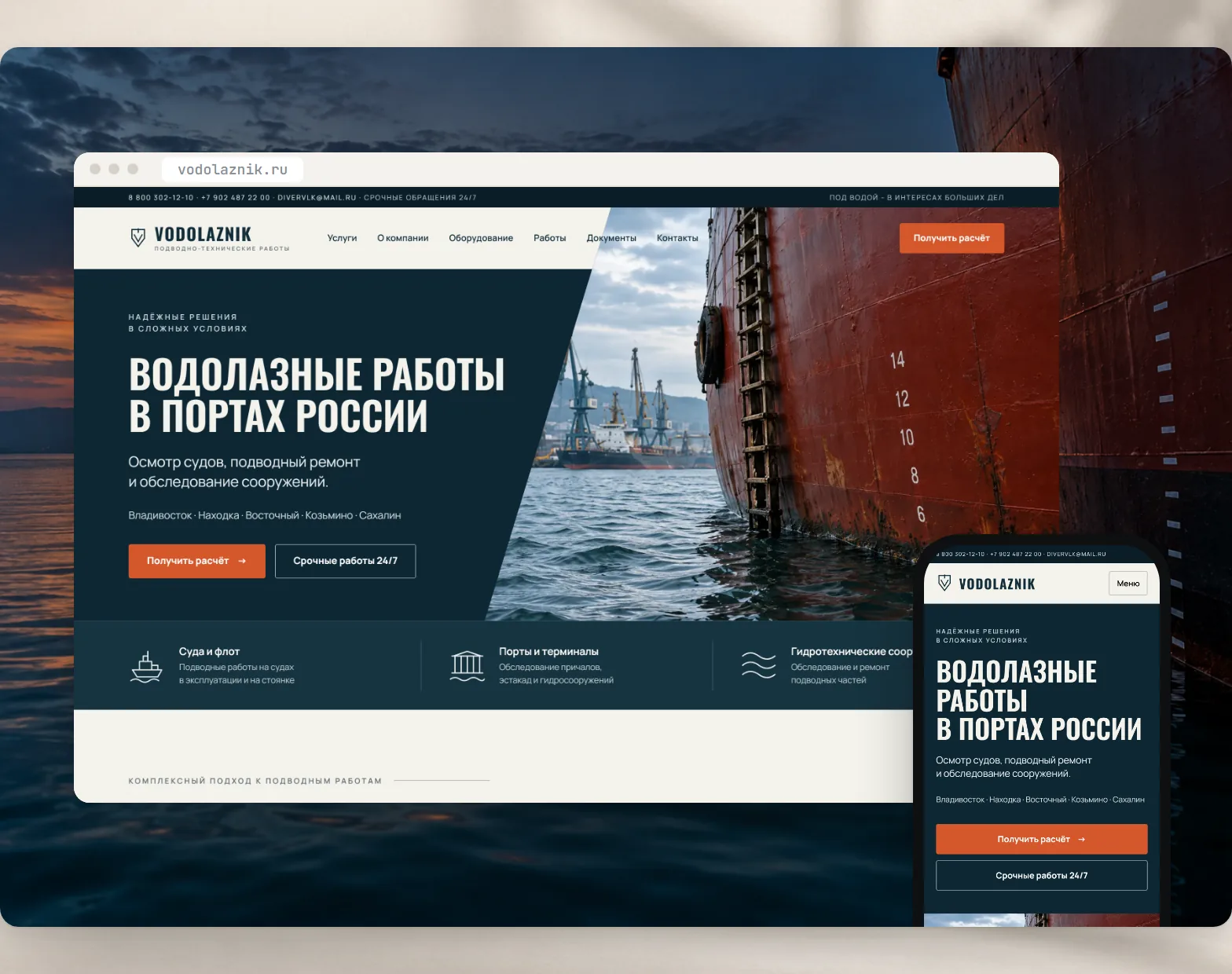
The company is based in Vladivostok and carries out underwater work on ships and quays. The domain vodolaznik.ru was parked on a registrar placeholder and the old sites ran with errors. We built a new WordPress site around how a client actually looks for a contractor: a specific job in a specific port. After launch we run the SEO.
The task
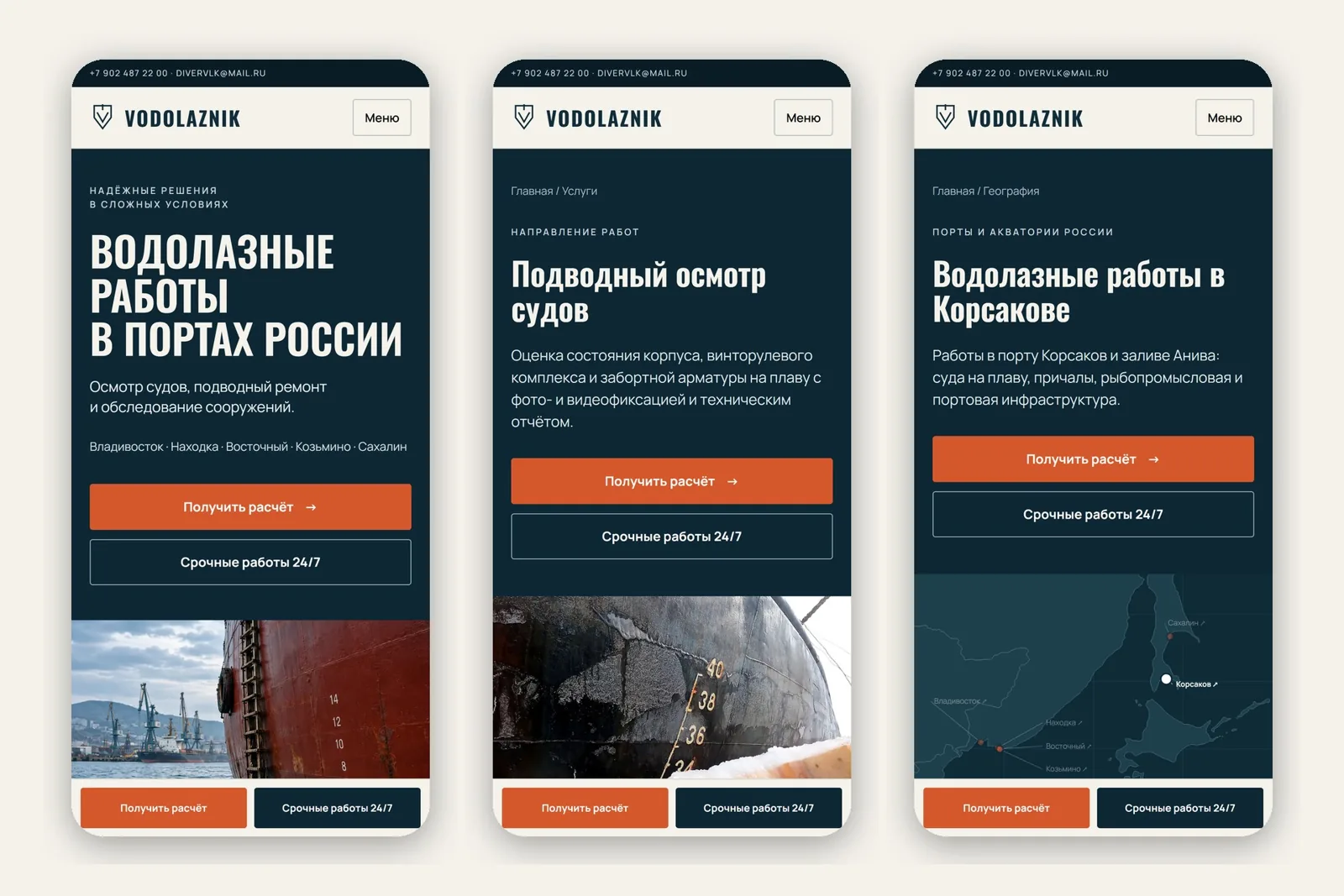
The chosen domain showed a registrar placeholder page, so the site was built from scratch. On one of the two earlier sites the About and Contacts pages returned 404, and on a phone at 390 px width the document stretched to 1024 px.
The client needed a site with an admin area where a ship owner or a port finds their type of job fast and sends a request with the starting data. After handover, promotion across Russia was added: new pages, indexing and company profiles on external platforms.
Our approach
We started with numbers. We reviewed 15 benchmark companies, ran 36 checks in Yandex Wordstat (Russia's main keyword demand tool) and built a working core of 114 phrases. The market turned out narrow and noisy: underwater welding has 1,532 queries, but the long tail is full of electrodes, training and salaries. Sea chest cleaning has only 4 queries, and we still built the page: it is a separate job, and without its own page there is nowhere to show it.
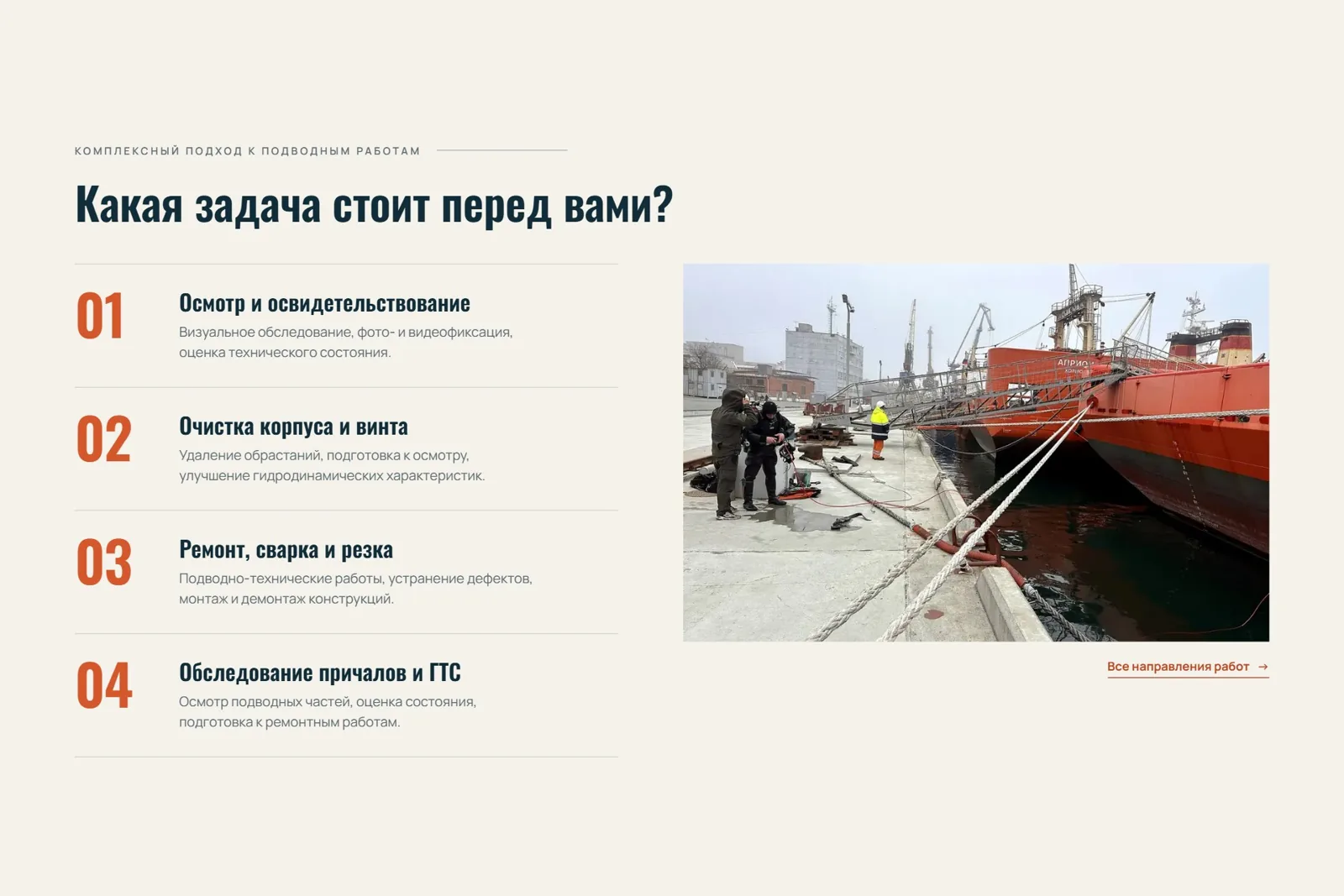
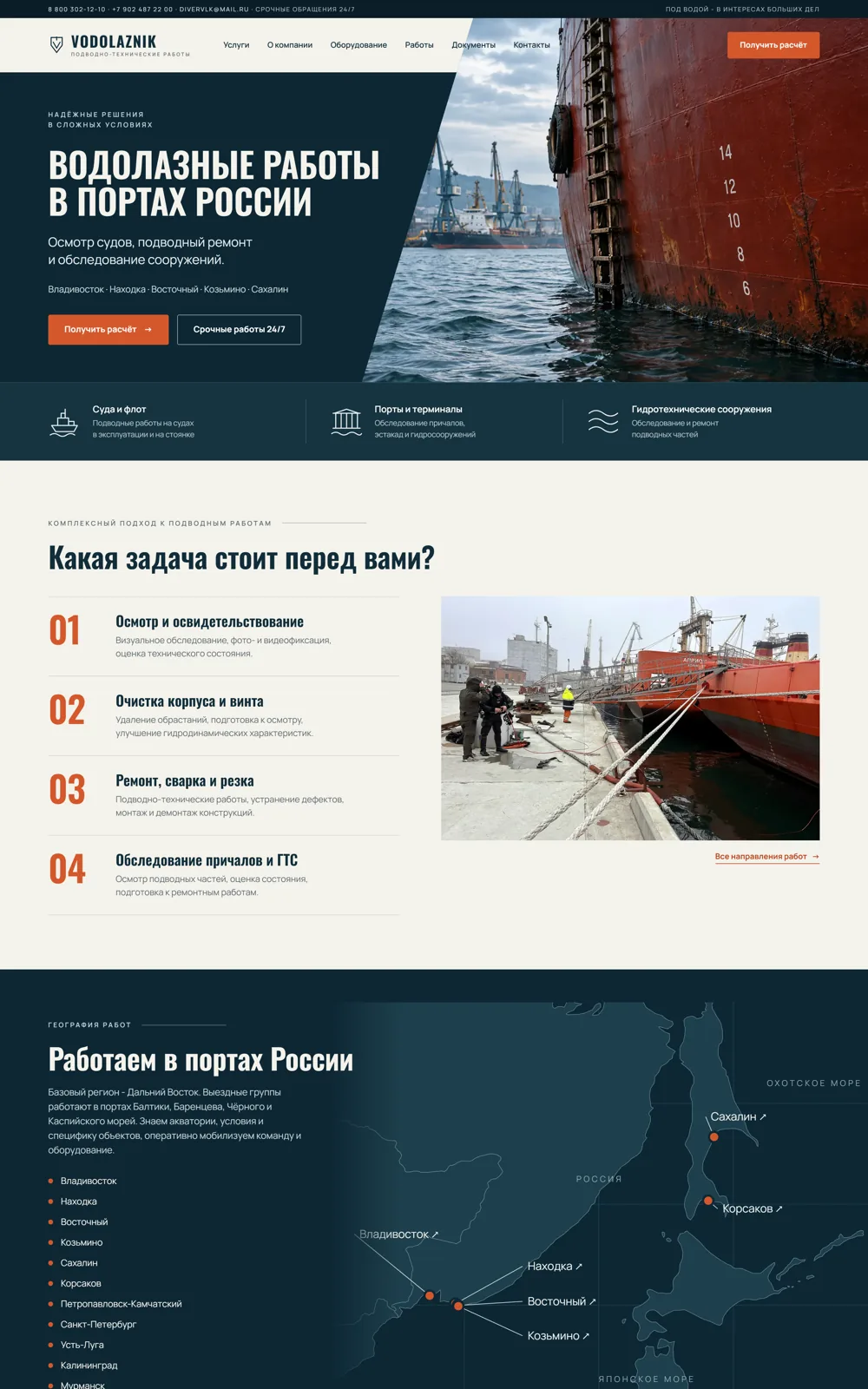
The site logic follows one chain: object, operation, place, starting data, proof, request. Every port got its own page. We did not multiply services by ports mechanically, to avoid piles of near copies: service-plus-port pages are made selectively, where there is something real to say.
Company details came only from verified sources. Legal details were checked against the Russian company register (EGRUL), and counters and achievements from the old sites were not carried over automatically because the figures there disagreed.
How the work went
Research
Audit of the domain and the old sites, competitors, demand. The output was a section map and 161 lines of requirements from the brief, each with a place on the site and a check criterion.
Design
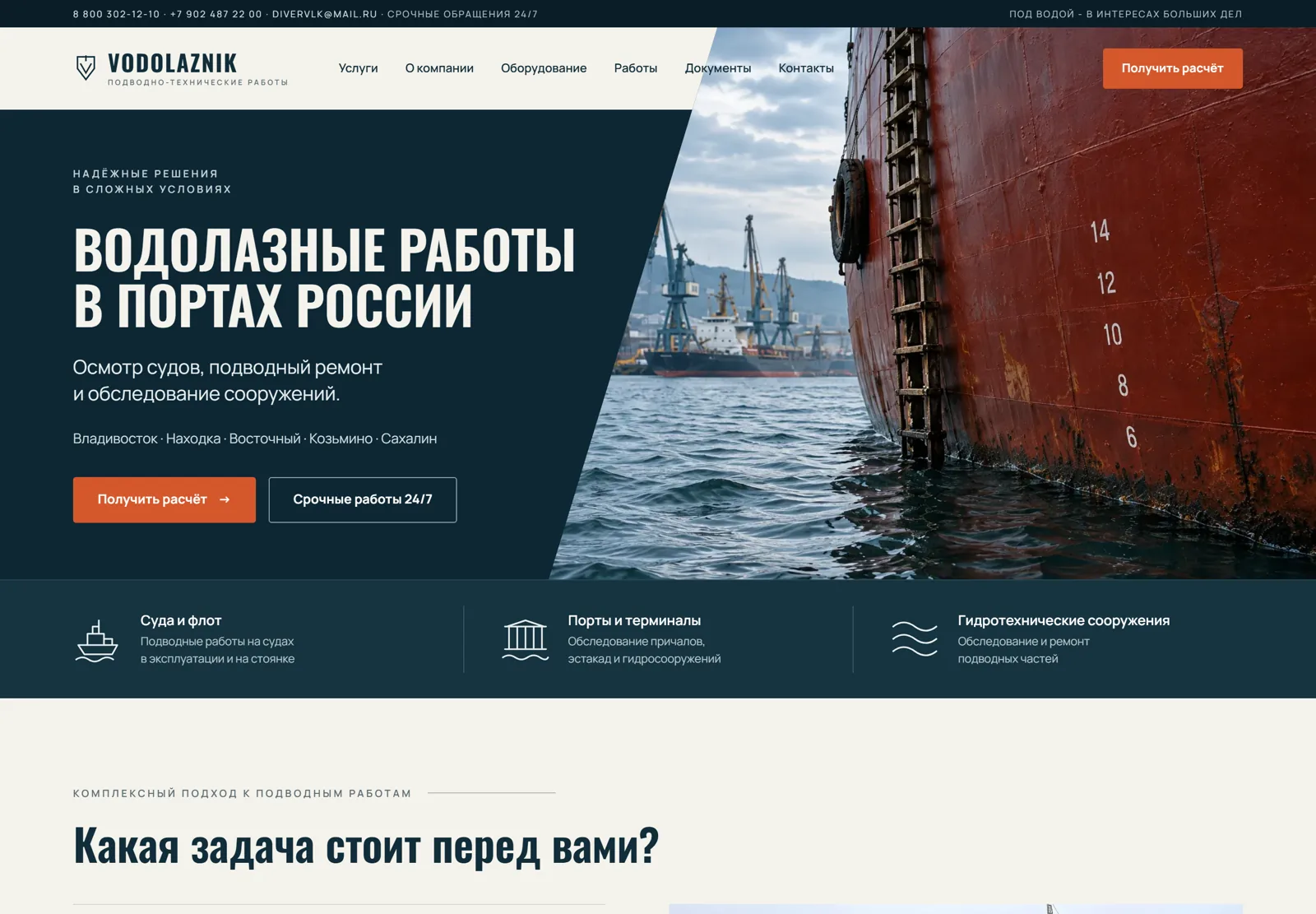
We showed four directions and the client chose the maritime one: industrial photos, large headings, light content blocks and dark geography sections.
Build
A custom WordPress theme. Service pages follow one scheme: when you need the service, what is included, starting data, result, timing, questions and answers. Photos and videos from the client's real jobs were captioned for image search.
Launch
Move to the client's hosting, HTTPS, documents under Russia's personal data law (152-FZ). Yandex Metrica starts only after cookie consent. For speed we added static HTML cache, images in several sizes and WOFF2 fonts.
Pages for a problem and a port
New materials cover propeller damage and rope or net fouling, plus separate pages on ship inspection in Vladivostok and fouling removal in Nakhodka. A database backup was made before every publication.
External platforms
We set up the company channel on Dzen (a major Russian publishing platform) with four publications and registered profiles in directories, including marine ones. Only confirmed company data went into the profiles.
What we delivered
- 53 pages: 16 services, 13 ports, 10 articles, 2 service-plus-port pages, company sections and documents
- custom WordPress theme and an admin area for edits without a developer
- schema.org markup: organisation, services, questions and answers, breadcrumbs
- request form with an email to the company
- Metrica goals for a request, a call, an email and Telegram
- Metrica, Yandex Webmaster and Google Search Console in the client's own accounts
- privacy policy, data processing consent and cookie policy
- voiced video made from the client's footage for the completed works section
- updated company card in Yandex Business: site, categories, photos and services
- 10 public company profiles, including Records Marine and Nautical Directory
Result
The site is live on the client's domain. The audit on 1 November covered all 53 URLs: every one returned code 200, with no errors in H1, canonical, noindex or markup, no duplicate titles or descriptions and no pages without internal links.
PageSpeed at the start showed 98 for the home page on mobile and 100 on desktop, and a service page scored 98. The Search Console report of 23 October shows 49 pages in the Google index. All four new materials were checked separately on 1 November and each is already indexed.
The counter, goals and search engine accounts belong to the client, so the client sees the contribution of every page directly.
- 53pages return code 200, audit of 01.11.2026
- 16service pages
- 13port pages
- 114phrases in the working keyword core
- 98 / 100PageSpeed of the home page, mobile and desktop, 02.10.2026
- 49pages in the Google index, report of 23.10.2026